Method Overview
Novel views
Spheres Segmentation
Spheres Highlight Segmentation
Edit - Color of Spheres
Edit - Rougher Spheres
Edit - Remove Spheres Highlight
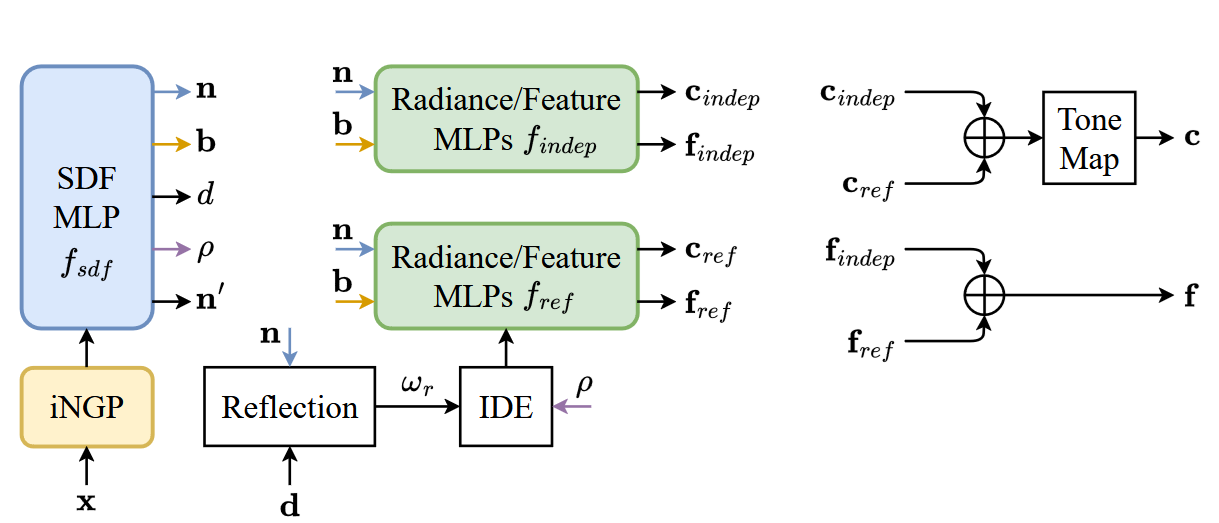
Recent work has demonstrated the ability to leverage, or distill, pre-trained 2D features, obtained using large pre-trained 2D models, into 3D features, enabling impressive 3D editing and understanding capabilities, using 2D supervision only. Although impressive, models assume that 3D features are captured using a single feature field and often make a simplifying assumption that features are view-independent. In this work, we propose instead to capture 3D features us- ing multiple disentangled feature fields that capture different structural components of 3D features involving view-dependent and view-independent components, which can be learned from 2D feature supervision only. Subsequently, each component can be controlled in isolation, enabling semantic and structural editing and understanding capabilities. For instance, using a user click, one can segment 3D features that correspond to a given object, and then segment, edit, or remove their view-dependent (reflective) properties. We evaluate our approach on the task of 3D segmentation and demonstrate a set of novel understanding and editing tasks.
Our method ability to segment object using only the independent part of a feature vector.
Spheres Segmentation
Cone Segmentation
Statue Segmentation
Plant Segmentation
Tabletop Segmentation
We leverage our ability to use the dependent part of a feature vector to show a novel ability of highlights and reflections segmentation.
Spheres Highlight
Windshield Highlight
Helmet Highlight
Car Highlight
Toaster Highlight
Edit capabilities of the independent and dependent (or both) color component after segmenting.
Total RGB
Independent RGB - 1
Independent RGB - 2
Independent RGB - 3
Independent RGB
Edit capabilities of roughness and removal of dependent color after segmenting.
Remove Spheres Highlight
Rougher Spheres
Remove sedan Highlight
Shiny Toasts
Remove Table Highlight
Rougher Body